Tech Ecosystems Workshops
Year: 2018
Scope: Reviewing, revising, and preparing workshop templates; workshop site visit and prep
Lead researcher: Barry Wylant
As a graduate student, I had the opportunity to assist with a unique research project, using human-centred design principles to explore how speech recognition technology could be integrated into care and life-improvement strategies for people aging in place.
When I joined the project, the research team was preparing for a series of co-design workshops with front-line health care professionals, such as nurses and occupational therapists, who regularly work with aging-in-place clients. I helped to prepare the sample materials and templates to be used in the workshops.
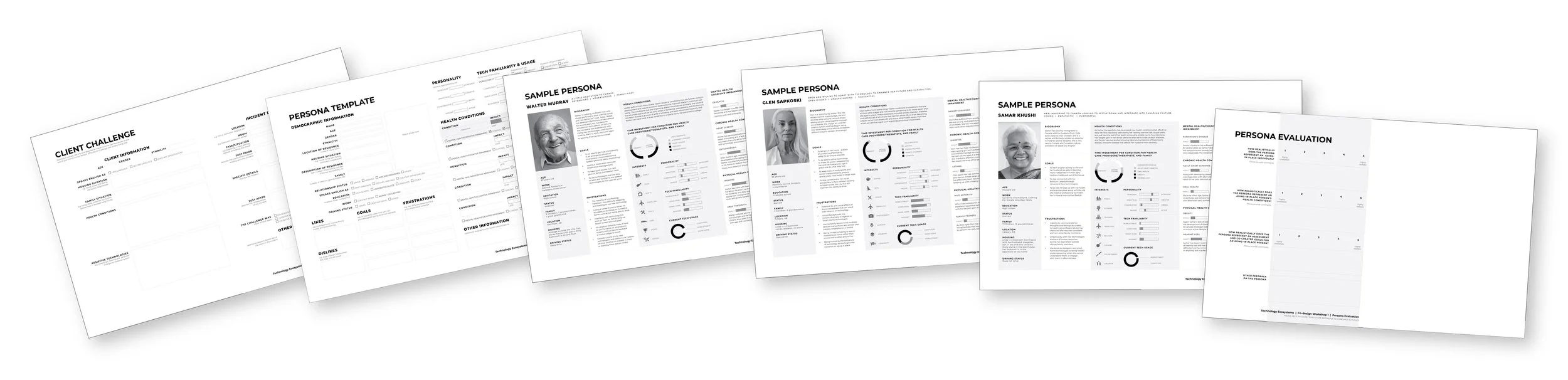
Workshop 1: Evaluating Personas
The first workshop focused on personas as a design and research tool. A persona is a fictional person who could fall within a given user group. Typically, the more detailed and realistic a persona feels, the more effective it will be. Personas can be defined with any number of personal details: a face, a name, an age, an educational background, a job history, a family structure, hobbies, etc.
Personas help designers and researchers step out of their own perspectives and approach problem-solving with greater empathy. Rather than proposing generic solutions for a monolith of average users, we’re more likely to generate novel ideas when we propose solutions for Walter, 87, who lives alone in an acreage outside Red Deer, and struggles to use a smartphone because of his progressing arthritis.
In the workshop, we presented our co-design participants with a set of three personas that the research team had already developed and asked for their evaluations. Each persona included:
A brief bio
Quick details about their age, work, education, relationship status, family, location, housing status, and driving status, and personal interests
Personality qualities
A list of health and wellness frustrations and goals
Scores to represent tech familiarity and usage
Detailed information about mental/cognitive, chronic, and physical health conditions and their relative severities
A recent medical history
Goals they are working toward with their health care providers and therapists.
We asked our expert participants to evaluate the personas. Were they realistic depictions of aging-in-place individuals? And did they represent health conditions accurately?
In an additional exercise, we asked participants to identify and describe an instance in the last few weeks where one of their clients encountered a difficulty or challenge with a daily living task.
Finally, we invited participants to create entirely new personas, based on the type of clients they work with. We provided a character sheet-style template with prompts, checkboxes, and blank scale bars that participants could fill in to define their persona’s demographics, characteristics, and health conditions.
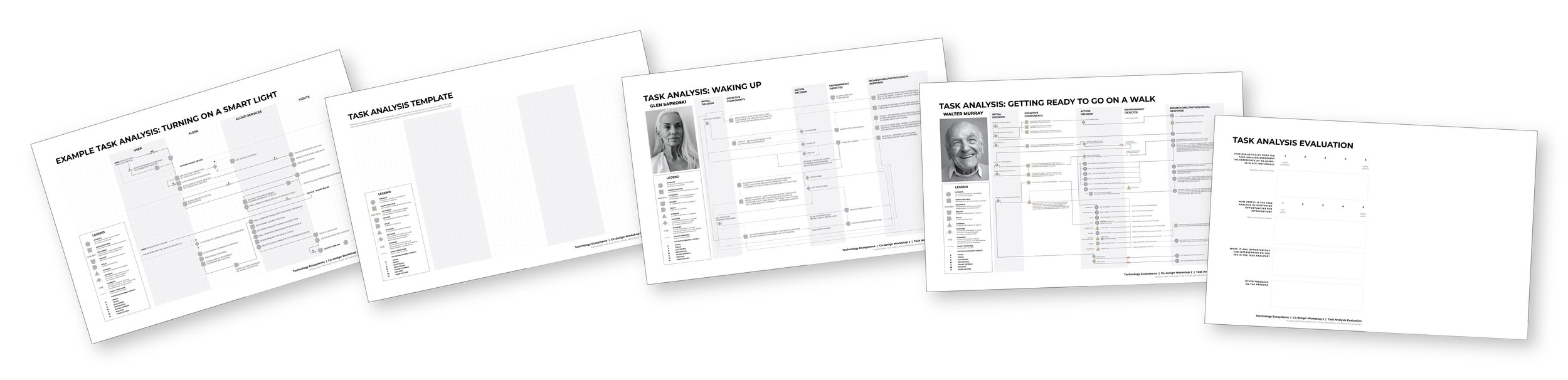
Workshop 2: Task Analysis
In Workshop 2, we focused on better understanding the types of day-to-day tasks that may be challenging for aging-in-place individuals.
We introduced participants to the concept of task analysis diagramming. The method takes what might seem like a single action, such as turning on a smart light, a breaks it down into discrete micro-actions and interactions between the user and the objects/environments/other people involved in the task.
The diagrams include symbols to represent different micro-actions such as operating, inspecting/reviewing, exchanging, receiving, delaying, storing, deciding, and transmitting. Micro-actions can apply to a wide variety of objects and information types, which is also noted on the diagrams. For example, receiving encompasses everything from data entering a server to a person being touched on the arm.
The task analysis diagrams show micro-actions mapped out in cause/effect sequences, making it clear how one event precedes another. For example, the auditory signal of a phone alarm going off prompts the user to make a decision about whether or not to hit snooze. Their decision leads them to operate their phone, touching this button, not that one, which stores specific data in the phone’s memory, which ends the auditory signal.
This all seems simple, and perhaps overwrought to think through, especially when a user completes a task without difficulty. But when a task becomes a struggle, task analysis can help to uncover non-obvious causes - trouble areas where the contingencies of the diagram break, form loops, or branch off in undesirable directions - and point to potential interventions.
Similar to the first workshop, we first asked participants to evaluate sample task analyses that the research group had developed. These were also contextualized by the personas from Workshop 1 since, while technology may usually follow consistent procedural actions, individual people may present significantly different cognitive and physiological responses to their interactions with people, technology, and the environment.
Once again. We asked our expert participants evaluative questions. Did the task analyses presented realistically represent the experiences of an aging-in-place adult? Did they reveal potential opportunities for intervention?
Following this, we invited participants to revisit the client challenge incident they had described in Workshop 1 and expand it into a full task analysis on a template we provided.
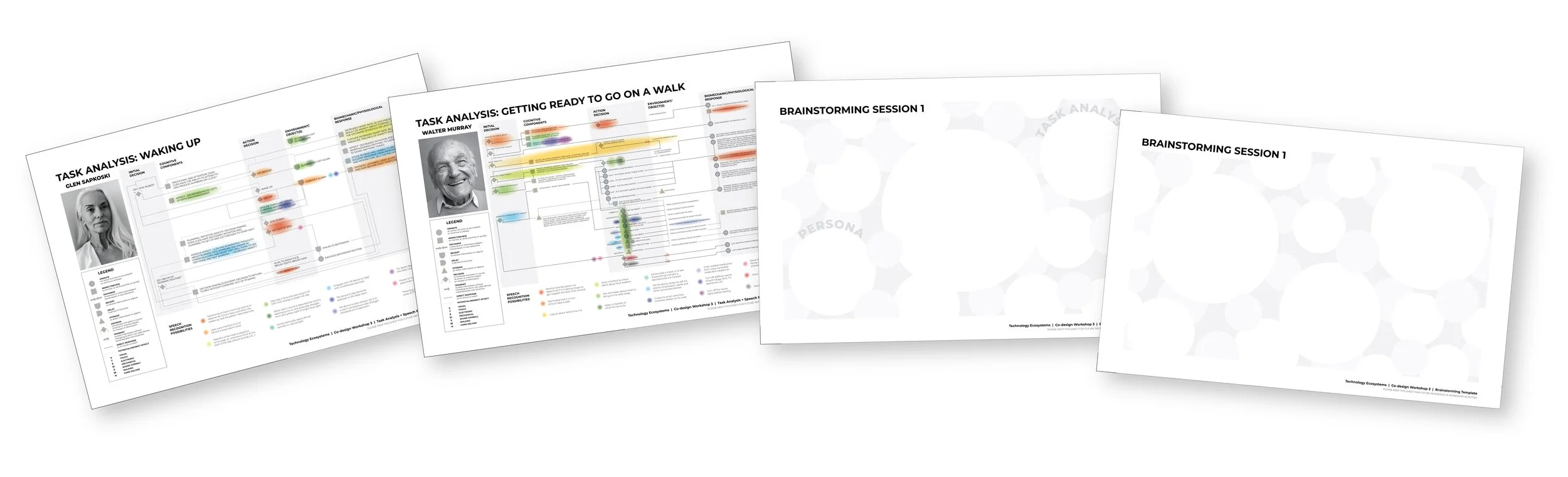
Workshop 3: Task Analysis + Speech Recognition Possibilities
Workshop 3 introduced the concept of speech recognition technology to the personas and task analyses from Workshops 1 and 2.
In our previous task analysis discussions, we looked broadly for intervention opportunities that might help with client challenges. This time, we focused specifically on interventions involving speech recognition technologies, particularly smart assistants such as Amazon Alexa and Google Home.
We presented our participants with updated persona-based task analysis diagrams, with areas for intervention highlighted and colour-coded to specific actions a speech recognition system could take. For example, instead of getting stuck in a loop of repeatedly snoozed wake-up alarms, a smart system could intervene by gradually adjusting the brightness and temperature of the room’s lighting to simulate a sunrise, or suggest playing one of the user’s favourite pop songs.
We asked our participants to apply the same type of thinking to the personas and scenarios they had developed to date. While the other ideation exercises had been very focused and template-driven, we left this final one broadly open-ended. We had given the participants much to think about over the course of three workshops and wanted them to uncritically capture any insights, unexpected connections, and perspective shifts the process may have sparked.